Consumer Staples: Playbook For Fall 2026. MICC+, DEO+, SAM+, EL+, MKC+, Food –
As many major consumer packaged goods (CPG) leaders prepare for next week’s Back to School conference, our biggest takeaway is the likely reckoning for calendar reporting food companies that already impacted mid-year reporters GIS, CAG & CPB (reports Thursday 9/3) — including potential long-term structural changes & reductions to FY 2027E consensus. While consumer stress, retail channel shift & GLP-1 have been well known since last fall, major headwinds have emerged since many 2026 outlooks were last updated. Since CAGNY, input costs jumped 20%, energy prices are up 33%, no recession came, and low relative valuations failed to catalyze major deals. Time is now up. As such, we suggest caution on the food sector despite ostensibly attractive valuations. On the other hand, we think MKC’s integration opportunity, select alcoholic beverage (SAM, DEO, STZ) & beauty (EL) leaders offer opportunities at low valuations, while GLP-1 resilient global ice cream leader MICC remains our favorite in the sector overall. Please join us and select beauty & spirits leaders at our luxury brands summit on 10/29 in NYC, and learn about how AI is affecting CPG at our AI ecosystem dinner on 9/16 in NYC.
Key Takeaways:
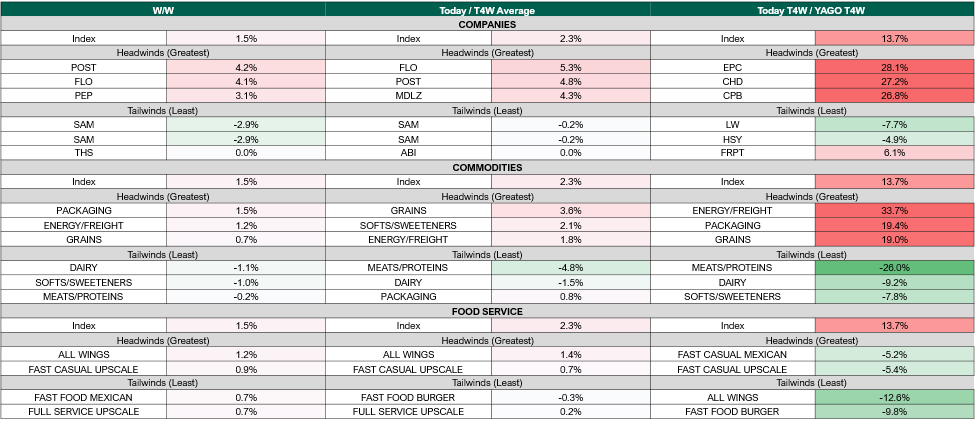
Cost Bounce Threatens Rest of Year, 2027 Staples Outlooks. The sudden 10-point change in y/y cost trajectory since early June is the latest chapter in this year’s input cost saga. Since CAGNY, weighted average spot costs are up +20.8% – a putative 400+ bps headwind to gross margins. Moreover, spot costs at that time were down -12.0% y/y and are now up + 13.7% — over 25 points of forecast whiplash since the February broad sector update. See Figures 3 & 4.
GLP-1 Adoption Good for Beauty, Bad for Food As Most Prized Consumers Adopt. While everyone knows about rising rates of GLP-1 adoption, the new demographics are changing the game. According to our recently published survey, 2026 adopters of GLP-1 are nearly 3× more likely to earn $200K+, less likely to lack a HS diploma (Index 34) and skew 55+. In our view, these desirable consumers are driving outsized retailer attention, which is a headwind for most food companies and a tailwind for select beauty companies.
Traditional Grocery Pain Spreading Upstream. Since CAGNY, pressures evident in shares of leading grocers KR (-19%), ACI (-41%) and even WMT (-21%) reflect the uncertainties as more costly delivery & digital routes to market are gaining share of CPG fulfillment. These can be opportunities for some, but broadly reflect more cost, less competitive advantage and less certainty for CPG incumbents.
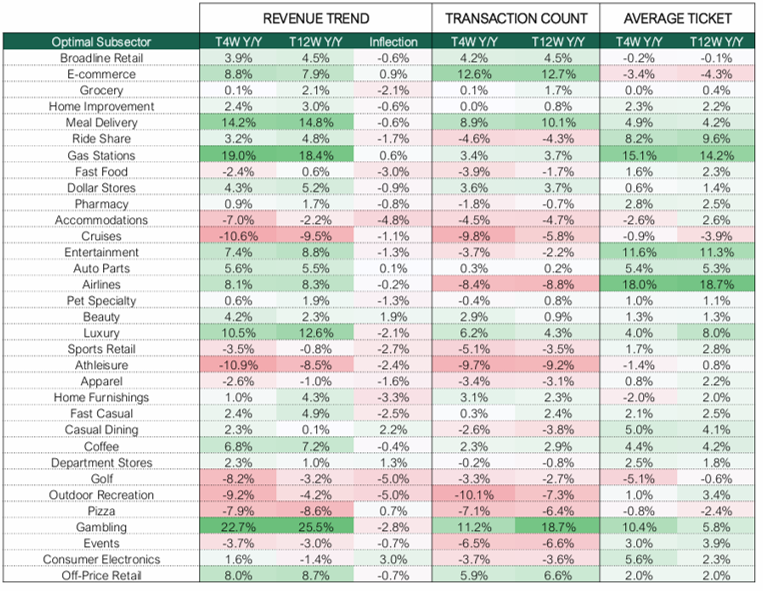
No Signs of Shift to Food at Home. Despite continued pressure on the mainstream consumer, grocers (+0.1% y/y, -210 bps inflection L4W vs L12W) are among the 25/33 tracked subsectors experiencing negative inflection as E-Commerce, Gas Stations, Gambling, Luxury and Meal Delivery lead consumer spending. See Figure 1.
Expect Another Wave of Food Strategic Talk as 2027 Plans Look Grim… Expect more plans that abstract more valuable assets as we identified above (e.g. occasion, distribution, margin) from less valuable portfolios. CPB’s snacking (43% of sales) is the most notable apparent opportunity, but one could envision a standalone CAG frozen business, a GIS pet business and many others. This is more evolution than revolution. KHC already announced a proposed split while others have announced strategic reviews.
…Yet Growth Anxiety Undermines Any Broad Floor Across US Food Assets. Lower valuations don’t move the math as much as uncertainty about long-term volume & recently eroded pricing power. The revenue drivers need to be sufficient to offset very clear & lasting inflation – including that of customer acquisition costs as technology changes including AI, co-manufacturing & logistical evolution enable more competition – and to allow hyperscalers & retailers to take a bigger share of the CPG pie. Of course, financial sponsors also must consider who the ultimate strategic buyer could be after their hold window – all of whom have their pick of the same assets today.
Opportunities We See:
Occasion matters in food. Seasonings > Protein > Pet > Indulgent Treats > Salty Snacking > Frozen > Center Store. They are all called “food” and valued similarly, but food businesses vary widely in their long-term strategic value, including the ongoing impact of GLP-1. This variation is based on customer acquisition cost, pricing power, purchase frequency, supply chain advantage & retailer leverage. In short – the ability to create incremental, high margin occasions, and fulfill low-cost repeat of same in today’s market conditions. Implications: MKC+, BRBR+, HRL+
We see silver linings in alcohol outlook. The alcohol market has improved this year, but with a wide range of performance across brands & product types. RTDs (SAM+), inexpensive imported wines, local craft beers, gin, cordials & select agave spirits like mezcal are performing well, while categories such as imported brandy, single malt, and premium tequila have softened. Drinking occasions don’t appear to be declining, but consumers – especially those aged 35–49 – are drinking differently. They are buying less in bulk but opting for higher-quality products. Retailers are adapting by allocating more prime shelf space to higher-margin products rather than focusing on volumetric best-sellers (DEO+, BFB+). Consumers are increasingly alternating between alcoholic and non-alcoholic options, reflecting changes in lifestyle and occasions rather than any secular generational trends.
Magnum Ice Cream Company execution shines while global food peers cut amidst GLP-1 pressure. Last month, the Magnum Ice Cream Company delivered H1 2026 organic sales growth of 4.7% split almost evenly between volume & price. That trajectory dwarfs virtually every CPG leader, with growth and share gain across all 3 regions. We think its Americas performance and recent peer management commentary show that premium frozen novelties are more insulated from GLP-1 than most, while global markets remain less affected as GLP-1 adoption is much lower and slower. Based on consensus 2026 Adjusted EBITDA of €1,318, the present valuation reflects roughly 10.5x EV/EBITDA on CY2026 — still a discount (~5%) to US food peers on a pro forma basis despite much better apparent prospects, likely reflecting an ongoing dislocation as the shares find permanent homes after the Unilever spinoff.
Figure 1: August 2026 Optimal Advisory Sector Spending Tracker
Sources: Optimal Advisory Proprietary Analysis, Bloomberg, FRED, USDA, BEA
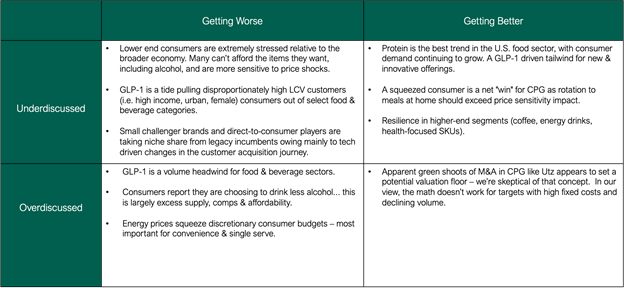
Figure 2: Sector Theme Box
Source: Optimal Advisory Analysis
Figure 3: Weekly Cost Factor Margin Context
Sources: Optimal Advisory Proprietary Analysis, Bloomberg, FRED, USDA, BEA
Figure 4: August 2026 Cost Factor Summary