Shhh!…..Santa Costs Are Coming to Town Cost & Tariff Relief Are Gifts for 2026 Food (and Wings!) Outlooks… and Few Will Likely Say
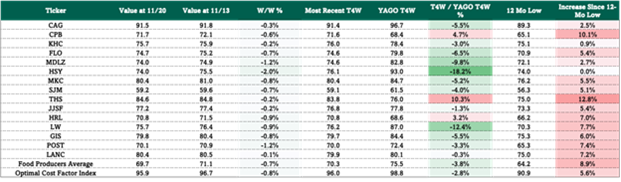
While the overall Optimal Cost Factor is down 8% YTD and 3.5% since 6/30/25, the average of weighted spot costs for the top 7 US based packaged food companies is down -18.1% YTD and -8.5% since mid-year.
For a sector that’s had little reason for optimism, relief from material costs & tariffs are clear holiday gifts for food companies that are probably not well enough advertised, if prior patterns hold. While we expect them to be downplayed in outlooks, these could be twin sources of surprise 2026 earnings visibility for food stocks facing poor volume & pricing. We expect more clarity upcoming in late January until CAGNY in late February.
Weekly wing prices are down -41% since August 1st, that has to help WING and other wing serving casual restaurants visibility for 2026 — with the vital holiday season and Super Bowl occasions just ahead.
Its a modest negative for food retailers’ comp outlook, with potential offsetting benefits in volume (due to affordability) and their bottom line as they could margin up on cost decreases in meat.
Here is our attempt to quantify the raw impact:
Figure 1: Staples Cost Factor Impact
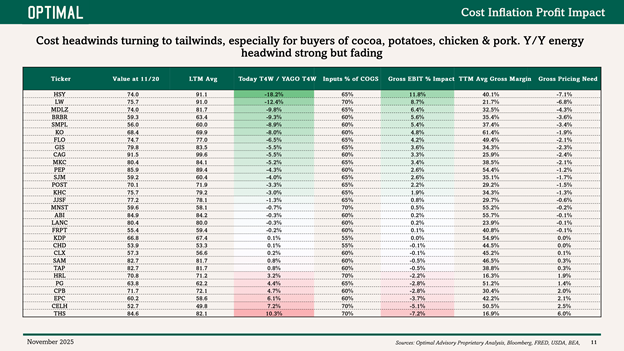
Figure 2: Food Sector Cost Factor Impact

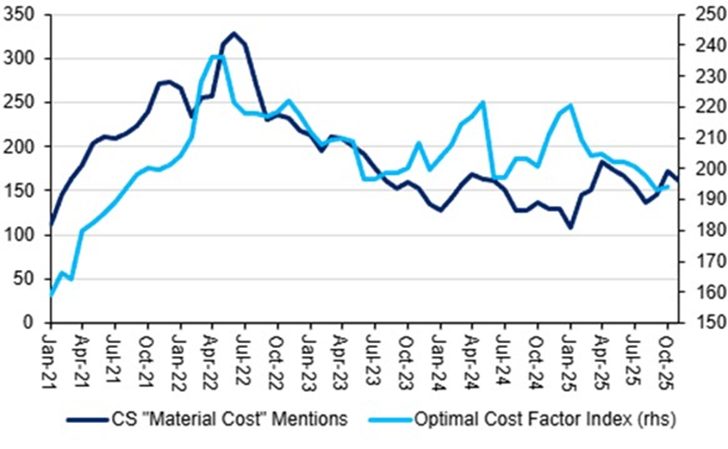
Managements talk a lot more about costs when they are naughty than when they are nice. Here are recent transcript mentions of “material cost” for the Consumer Staples sector components of the Russell 3000 plotted against weighted average spot input costs.
Figure 3: Material Cost Transcript Mentions vs Spot Costs
Surprise tariff relief coincides with cost tailwinds. On November 14th, the Trump administration announced the immediate rollback of tariffs on dozens of key food related items, in an apparent attempt to lower grocery bills. BEFORE this surprise announcement, many big cap food leaders went on record to itemize the impact of tariffs broadly.
Specifically:
- HSY said, on 10/30/25, tariffs $200 million incremental (175 bps margin impact). This is in addition to our calculated -18.2% EBIT tailwind mainly from spot cocoa cost declines. Management has previously noted several dollars of EPS impact from cocoa cost headwinds.
- MDLZ said, on 4/29/25, a small but manageable impact.
- MKC said, on 10/7/2025, $140 million annualized. This would be a roughly 200 bps margin impact.
- CAG said, on 11/12/25, 3% of material cost inflation — which was 60% of COGS – a 180 bps margin impact.
- KHC said, on 7/30/2025, annualized impact of 180 bps to cost inflation. This would be a roughly 50 bps margin impact.
- GIS said, on 9/2/25, 1%-2% of costs.