MICC: Structural Advantages & Execution Proving Stronger Than Headwinds
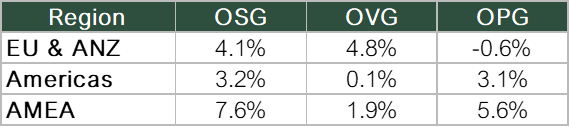
Growth & margin expansion on schedule, while global food peers cut amidst GLP-1 pressure. Last month, the Magnum Ice Cream Company delivered H1 2026 organic sales growth of 4.7% split almost evenly between volume & price. The highlights included full year guidance of 3% to 5% organic growth despite tougher comparisons and nearly doubled FCF (€273 million vs €138 million) — albeit with roughly two thirds of that increase reflecting one-time separation benefits from Unilever. That trajectory dwarfs virtually every CPG leader, with growth and share gain across all 3 regions. We think its Americas performance and recent peer management commentary show that premium frozen novelties are more insulated from GLP-1 than most, while global markets remain less affected as GLP-1 adoption is much lower and slower.
Significant relative value on 2026 Outlook, with more likely ahead. Based on consensus 2026 Adjusted EBITDA of €1,318, the present valuation reflects roughly 10.5x EV/EBITDA on CY2026 — still a discount (~5%) to US food peers on a pro forma basis despite much better apparent prospects, likely reflecting an ongoing dislocation as the shares find permanent homes. While capture of separation costs has likely been ahead of schedule, we think at least €200mm in remaining separation costs included in C2026 consensus are likely to sunset in 2028 – suggesting a much steeper pro forma discount.
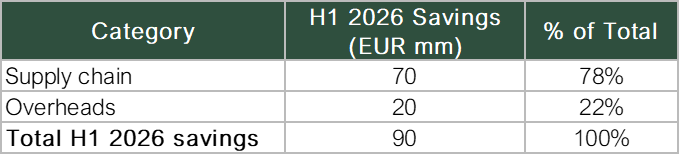
The margin opportunity is credible due to mix, costs & Unilever. A continuous focus on the premium and away from home segments should drive profit per occasion and overall margin higher. In the near-term, we note sharp tailwinds from input costs including cocoa globally and dairy in the US. Finally, we note apparent margin opportunity relative to peers (e.g. PG) is evident across Unilever’s portfolio, lending credence to Magnum’s targeted 200 bps in overhead reduction.
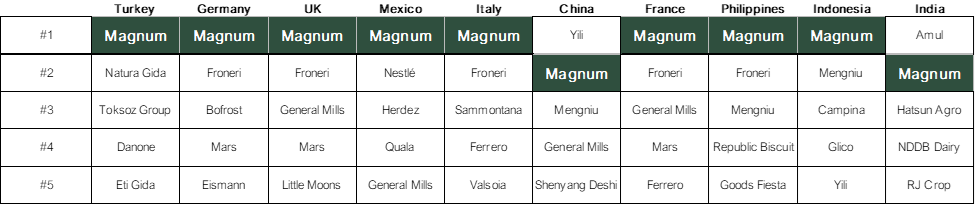
Much better outlook than most US based food businesses. Magnum’s focus on premium & super premium products in developed markets, away from home consumption (40%+ of global sales), and emerging markets (31% of global sales) drives a much more attractive outlook than that of US based food peers. We note the “premium plus” segments of developed market ice cream have grown faster than mainstream (5% vs. 3%) with superior gross margin. Increased cabinet placement – adding to its dominant global cabinet share (30%) — should drive EM growth alongside superior demographics & increasing buying power in those markets.
Complexity of the value chain powers a better diversified business model. Unilever management cited heavy seasonality, an expensive frozen cold chain, and little point of sale overlap as reasons for the spin off. In the hands of a focused management, these are also barriers to entry that compare favorably to global peers who face similar challenges without Magnum’s scale. The supply chain strength drives an unusually diversified channel mix, including over 20% of sales in China from the digital channel.
Figure: H1 2026 Performance Summary
Source: Company Reports and Optimal Advisory Estimates
Figure: H1 2026 Channel Summary

Source: Company Reports and Optimal Advisory Estimates
Figure: H1 2026 Value Capture Summary
Source: Company Reports and Optimal Advisory Estimates
Figure: Key Global Market Leadership Outside US
Source: Company Reports and Optimal Advisory Estimates