General Mills: Similar Set Up to Conagra — Risk & Change Likely Ahead
On Monday, Conagra’s board replaced its CEO with another industry insider, effective June 1st. The move came as fiscal 2027 (May) plans were taking center stage, after disappointing recent stock performance. We think the market’s negative reaction was rightly based on concerns that forecasts will be reduced, potentially threatening their large dividend. As such, we suggest caution on General Mills, noting its situation mirrors that of Conagra in several key ways.
Specifically:
- Recent signs that “on algorithm” growth plans are unlikely to be achievable in FY 2027. Just 2 months after striking an optimistic tone on the impact of tactical price reductions, General Mills pre-announced disappointing results in February – yet surprisingly maintaining their FY2026 (May) forecast. Considering the rarity, risk and cost of tactical price reductions, we infer that their impact was much worse than modeled internally for the February quarter and that much inflection would be needed to make up the shortfall. For its part, Conagra’s results were recently impacted by supply chain issues.
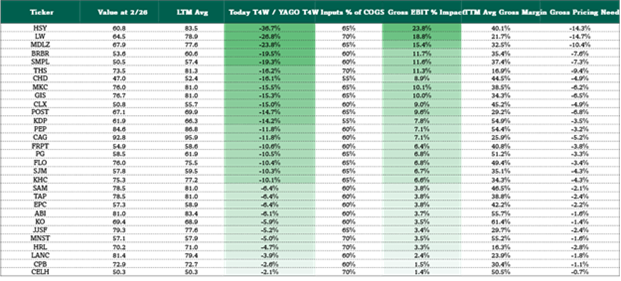
- On the eve of the Iran war, General Mills had a putative 650 bps raw gross margin tailwind, while Conagra’s tailwind was 520 bps — both substantially now gone from the 2027 planning process just 6 weeks later. While many input costs are hedged, the sudden change in spot costs must heavily impact fiscal 2027 plans – especially in the context of targeted price reductions that had presumably been funded by planned input cost relief.
- Poor 5-year stock performance, worsening in the past year. GIS’ (-40% y/y, -44% L5Y) stock performance is directionally similar to that of CAG (-44% y/y, -62% L5Y), based on similar structural pressures.
- May fiscal year-end = out of time. General Mills & Conagra share a May fiscal year end. While calendar reporters have time to “wait & see” on an FY 2027 plan, they do not. For all their recent volatility, food companies can credibly hope to be volume benefactors if the shock of Iran war leads to further consumer strain & recession (cf. 2009). Furthermore, Campbell’s July fiscal year end may trigger a similar process shortly (CPB -45% y/y, -58% L5Y) ….. more on that later.
- Large dividend payout limits financial flexibility for a reset. General Mills’ 84% ratio of TTM dividend payments to operating FCF (OCF minus capex) is similar to Conagra’s ratio of 79%. If gross profits seem likely to miss plan, it’s increasingly a question of either cutting marketing or cutting the dividend – neither of which tend to be well received.
- Both have above target financial leverage since transformative, comparably sized deals in 2018. In 2018, General Mills bought Blue Buffalo for $8 billion, while Conagra bought Pinnacle Foods for $10.9 billion. While Blue Buffalo had much more immediate success for General Mills, the trend in organic gross profit for both companies’ legacy businesses has been disappointing. As such, neither balance sheet has returned to their own targets or pre-2018 levels.
- Tenured, well-liked CEOs. Jeff Harmening took the reins from Ken Powell in June 2017, just 2 years after Sean Connolly took over at Conagra. Both are affable, persuasive & seasoned CEOs with an optimistic view of their companies’ respective core brands.
We see outsized risk of a strategy and earnings reset for General Mills, while a much lower chance of any external management change. While they face similar near-term dilemmas, General Mills’ situation differs from that of Conagra in two important ways. First, General Mills’ management has remarkable continuity (just Sanger, Powell, Harmening at CEO since 1995) and has always promoted internally. We don’t expect this to change. Secondly, General Mills brands have greater strategic value, given broadly higher gross margin and share profiles. However — like Conagra – General Mills has a long-standing, organically eroding base of gross profit, with no easy strategic fix, no obvious consolidator and a threatened dividend. As such, we think the risk of their apparent options entering fiscal 2027 outweigh the apparent rewards.
Figure 1: Industry Wide Cost Factor Snapshot – 4/10/2026
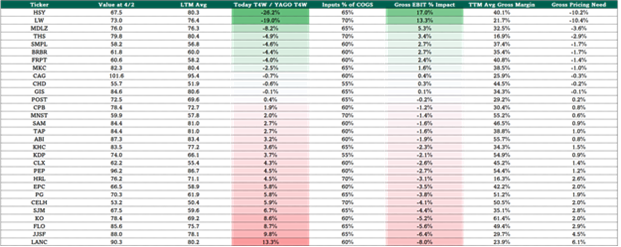
Figure 2: Industry Wide Cost Factor Snapshot on Eve of Iran War – 2/27/2026