Relative Capex, AI Search Monetization & Gemini 3.5 Keys to GOOG Earnings
7 Key Issues We’re Watching Tomorrow
What we would act on
Three things: any change to 2026 or 2027 capex expectations, read alongside backlog and capacity commentary; Search monetization relative to AI query growth and cost per response; and a concrete Gemini 3.5 Pro date with credible economics on Apple and external TPU deployments.
A headline revenue beat driven by Cloud hardware or FX would tell us considerably less than evidence that AI revenue and gross profit are compounding faster than depreciation and inference costs.
1. Search growth, owning more of the customer graph, and Ad revenue and EBIT
The open question is whether AI Overviews and AI Mode add to Search economics or merely defend query share. Q1 Search revenue grew 19%; management pointed to higher usage, including commercial queries, and to a reduction of more than 30% in the cost of a core AI response. AI Mode has since passed a billion monthly users, with queries more than doubling each quarter.
We want revenue per query rather than query counts, ad coverage and pricing on longer conversational queries, inference cost and latency per response, and TAC growth — particularly to distribution partners. The decisive disclosure is whether AI Mode generates new search occasions or reallocates activity away from the profitable ones.
Reassuring: double-digit revenue growth persisting as AI unit costs fall and coverage widens. Concerning: query growth accelerating while ad revenue decelerates.
Figure: Google engagement is rising as the open web’s traffic falls
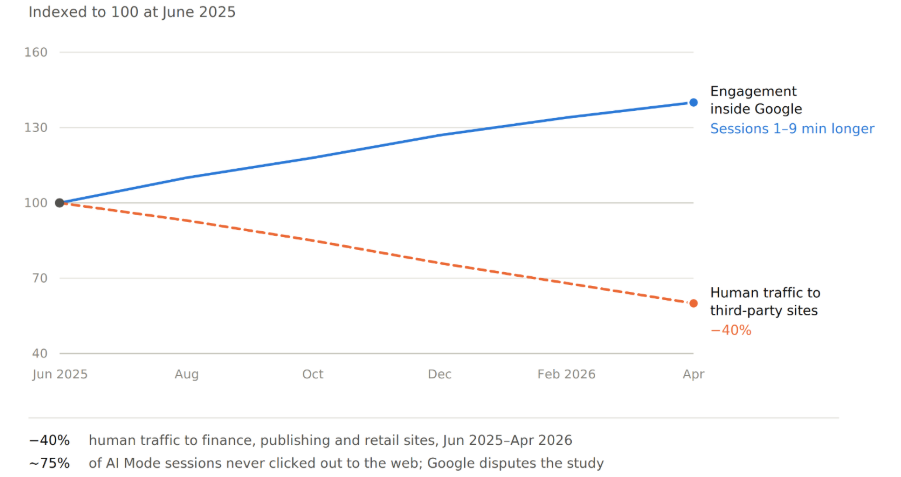
Source: Optimal Advisory analysis, Cloudflare, Google
2. Capex trend vs free cash trend.
2026 capex guidance has been raised to $180–190bn against $35.7bn spent in Q1, with 2027 flagged to rise significantly. Roughly 60% of Q1 technical infrastructure went into servers, 40% into data centers and networking.
The distinction that matters is demand-backed capacity versus speculative capacity. We are looking for the Q2 run rate, how much is committed against signed Cloud demand as opposed to internal training and consumer inference, the depreciation and energy burden landing on 2026–28 EBIT, when utilization catches up with installed capacity, and whether free cash flow troughs before capex growth does.
A further capex increase unaccompanied by higher revenue or backlog guidance would be the least welcome outcome of the call.
3. Cloud must show that its growth is organic and its margins durable.
Cloud remains the clearest evidence that the spending earns a return. Q1 revenue grew 63% to $20bn at a 32.9% operating margin, with backlog of $462bn, slightly more than half of which Alphabet expects to recognize within 24 months.
We would separate recurring GCP consumption from TPU hardware, acquisitions and outsized contracts; establish whether customers are consuming above contractual commitments; and test whether capacity still constrains revenue. Margins holding near 30% through rising depreciation and the Wiz dilution would be a good result. Growth that is increasingly hardware-led or acquired, with margins falling faster than guided, would not.
4. Any indication that delay in Gemini 3.5 Pro availability is non-normal?
Google said at I/O that 3.5 Pro would ship in June; the launch has reportedly slipped. That makes this a credibility event, and a firm general-availability date is worth more than any benchmark slide.
Beyond coding, agentic and enterprise performance, we care about inference cost, latency and API pricing, and about token volumes, app engagement and paid conversion. Model quality is a financial variable: it drives Cloud share, developer adoption, Search engagement and the compute required per useful answer. If management answers with ecosystem breadth rather than model competitiveness, read that as an answer.
5. Unit economics for Apple AI deal.
Apple has confirmed that its third-generation Foundation Models comprise five models built in collaboration with Google, with the most capable server model running on NVIDIA GPUs in Google Cloud inside Apple’s Private Cloud Compute architecture.
The questions are financial rather than technical. Is Alphabet paid for development work, capacity, inference, licensing, or all four? When does recognition begin, and on what basis — usage, capacity or fixed fee? What minimums, term and renewal provisions apply, who funds the GPUs, and how portable are the workloads? Contract terms will not be disclosed, but directional language on scale, timing and accounting would be informative. A multi-year recurring inference relationship with real minimums is a very different asset from a bespoke, capital-hungry arrangement Apple can move elsewhere.
6. Impact of TPUs business on margins.
Alphabet intends to sell TPUs directly to selected customers for installation in their own data centers, with only a small share of revenue recognized in 2026 and the bulk in 2027. We want bookings and pipeline, gross margins relative to GCP consumption, and whether hardware pulls through software, networking and Cloud revenue. Two risks: that external sales divert scarce capacity from higher-return internal and Cloud workloads, and that a structurally lower-margin, working-capital-intensive revenue line is being celebrated as backlog. Customer concentration is worth asking about.
7. Growth rate of GOOG Ebit engines vs. cost of the AI build-out.
Alphabet is highly profitable today: in Q1 it kept just over 45 cents of every dollar of Services revenue and just under 33 cents of every dollar of Cloud revenue as operating profit. Management has warned that this will get harder, because the AI build-out brings four new costs — writing off the servers and data centers over their useful life, the electricity to run them, the compute consumed every time a model answers a question, and the pay packets needed to hire AI staff.
So, the arithmetic is simple. Extra profit from Search, Cloud, YouTube and subscriptions has to more than cover those four costs, plus the drag from acquisitions and legal bills. The single most useful comparison on the call is whether write-offs are growing faster than revenue. If they are, revenue can rise handsomely, and profit still go nowhere.
Also worth noting headcount and pay growth, Services margin stripped of one-off legal charges, Cloud margin after the effect of acquisitions, and whether management still talks about taking cost out of the business or has stopped mentioning it altogether.
Figure: Expanding ownership of the Customer Graph, maintaining unit economics TBD
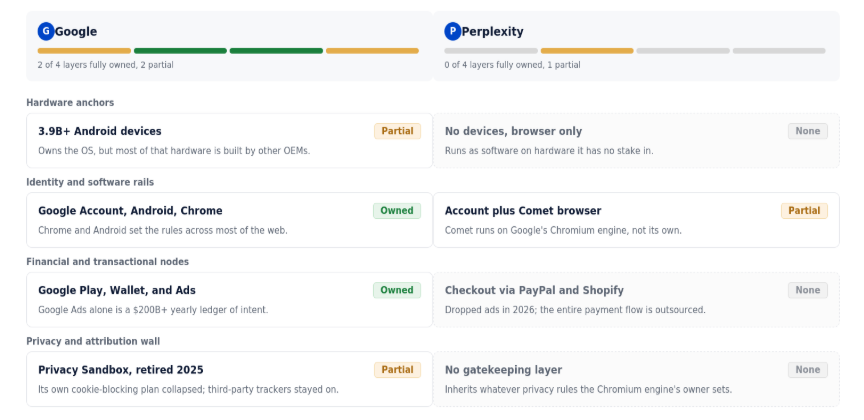
Source: Optimal Advisory analysis, Google earnings, Perplexity public statements