Ten Thoughts on the Anthropic IPO / What to Look for in the S-1
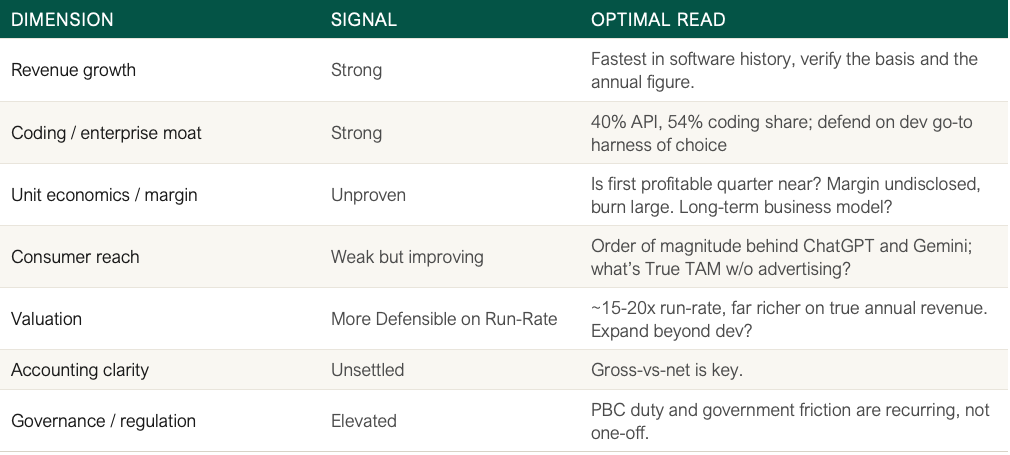
Anthropic filed a confidential draft S-1 in June, with a public prospectus expected after Labor Day. We’ve identified 10 pre-IPO factors to clarify how an AI developer moat becomes a sustainable business and whether further Enterprise and Consumer expansion support a massive multi-trillion $ TAM. Our channel checks are focused on Enterprise workflows, especially developers, and support our bullish view on Anthropic’s dominance in the Enterprise AI market. We will revisit the IPO prospects after the release of the S-1, incorporating our weekly 5 Tech Themes and updated checks to apprise our view on key signals we discussed below.
Sources: Optimal Advisory
1/10
Run rate 7x in a year but what’s pilot/annual/multi-year mix and annualized forecast for 2027?
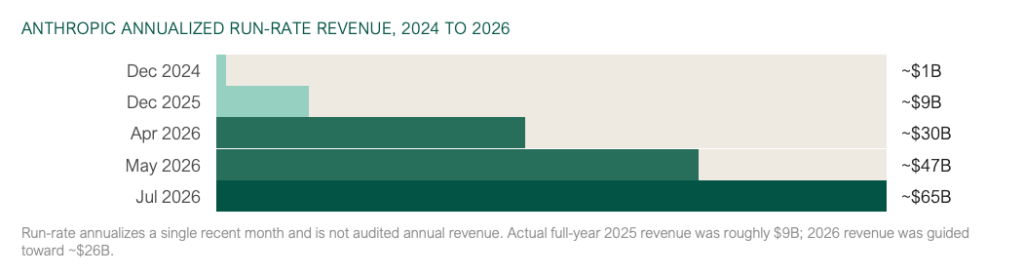
Anthropic’s run-rate went from roughly $9B at the end of 2025 to $30B in April, $47B in May, and $65B by the end of July 2026, a sevenfold jump in a single year, with preliminary Q2 revenue of about $11.5B versus $787M a year earlier and the first-ever quarter of positive adjusted operating income. We’re looking for audited full-year 2025 and interim 2026 revenue on a GAAP basis, the exact definition of any run-rate used, guidance on pilots and trials vs, longer term commitments, and quarter-over-quarter sequential growth not an annualized month.
Sources: Optimal Advisory, Anthropic, Bloomberg, CNBC
2/10
Gross-versus-net rev is critical disclosure
Anthropic reports revenue billed through its cloud partners on a gross basis, counting the full end-customer amount and booking the cloud’s cut as an expense, which inflates the top line relative to net-reporting peers. We’re looking for the size of cloud-partner cost of revenue and actual net revenue and potential channel conflicts from top partners.

Sources: Optimal Advisory, Anthropic
3/10
Software development is Anthropic’s most attractive moat
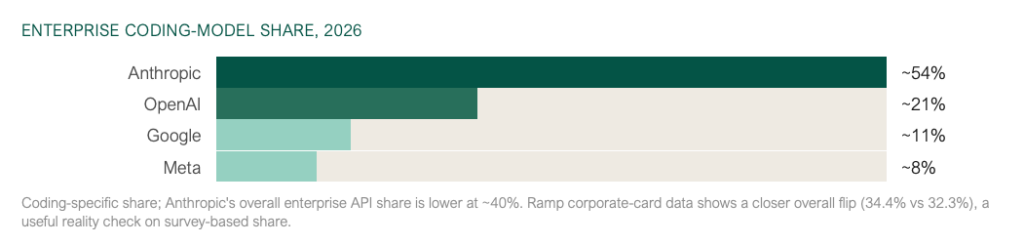
Anthropic leads enterprise LLM API share and the lead is widest in coding, where Claude holds an estimated 54% versus OpenAI’s 21%. Claude Code went from launch to over $2.5B run-rate inside a year and now drives more than half its revenue from enterprise. Our checks confirm Claude has brand leadership in Enterprise development, but OpenAI Codex has gained enterprise dev share (users + token output). We’re looking for revenue growth and concentration by product (how much is Claude Code), net revenue retention, and customer counts by revenue per segment, which reveal whether the coding beachhead is expanding into broader enterprise workflows.
Sources: Optimal Advisory; Ramp AI Index; Anthropic
4/10
Agentic consumption, not price hikes, drive revenue compounding
A Claude Code developer reportedly consumes $6 per day, and multi-agent workloads consume about 15 times the tokens of a single chat. This lets revenue compound roughly tenfold a year without raising per-token prices (note: this ties revenue directly to compute cost, and unlike SaaS has heavier COGS). We’re looking for revenue per customer trends, the share of revenue from agentic versus chat workloads, and any disclosure tying token consumption growth to cost of revenue, which tests whether consumption growth is accretive or passes through to the hyperscalers.
5/10
Enterprise is now, Consumer is future, what’s True TAM?
ChatGPT leads Consumer AI with roughly 800 to 900 million weekly users and Gemini ~ 650 million MAUs (AI Overviews ~2.5 B MAUs), but Anthropic reports accelerating Claude’s consumer share since January 2026 to reportedly ~20% of market. We’re looking for the split of revenue between API/enterprise and first-party subscriptions, consumer MAU if disclosed, and how management frames total addressable market given the current focus on Enterprises, share gain in.
6/10
To date compute = $$$ cash burn
Anthropic is making enormous present and long-term compute commitments ahead of demand. More granular signposts to connect required outflows with anticipated revenue would be welcome. It presently runs across Amazon Trainium, Google and Broadcom TPUs, and Nvidia GPUs. They’vae also signed multi-gigawatt, multi-year capacity, including a reported SpaceX GPU deal near $1.25B per month through May 2029 and a Google and Broadcom expansion adding 3.5 GW in 2027. That build underwrites a $200B 2028 revenue ambition but also drives large cash burn: cumulative losses are estimated at $10 to 15B since 2021, even as a first ~$1B quarterly operating profit is projected for Q3 2026. We’re looking for disclosed gross margin and its trajectory, total contractual compute and purchase commitments, off-balance-sheet obligations, related-party transactions with Amazon and Google, and the cash runway against the burn rate.

Sources: Optimal Advisory, Forbes, Company Filings
7/10
Does sticky Claude Code harness beat the commoditized model middle of the stack
Half a dozen labs ship near-equivalent frontier models and leapfrog every few weeks and open-weight Chinese models are closing to within a few months of the frontier. Anthropic serves frontier-quality intelligence months ahead of rivals at scale, and our checks confirm developer ICs and teams favor Claude harness for most of their key workflows. We’re looking for the risk-factor language on competition and pricing, any disclosure of price-per-token trends, gross margin by product, and customer concentration, which together indicate whether pricing power is holding or eroding.
8/10
The multiple looks defensible on run-rate revenue, not at reported revenue
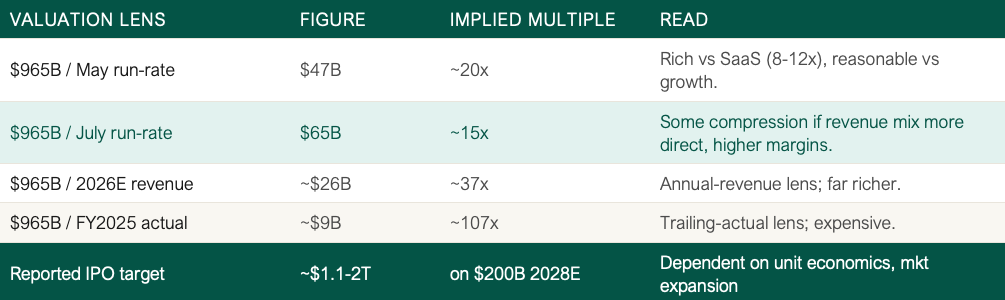
At a $965B (Series H) valuation against a $47B May run-rate, Anthropic priced at roughly 20x trailing run-rate, actually below OpenAI’s implied multiple on its smaller revenue base, and at the $65B July run-rate the multiple compresses toward ~15x. Top-quartile public SaaS trades at 8 to 12x revenue, a premium but not extreme against the growth rate and potential TAM and existing moat. But measured against annual revenue (~$9B for 2025, guided toward ~$26B for 2026) rather than an annualized month, the same $965B implies a multiple several times higher, and the reported ~$1.1 to 2T IPO target rests on a $200B 2028 revenue schedule. We’re looking for the offering price range when it sets, audited revenue for the denominator, the basis (gross vs net) that revenue is stated on, and any management projection language that would anchor the 2028 forecast.
Sources: Optimal Advisory, Forbes, Axis Intelligence
9/10
Safety and structure are assets with potential real downside risks
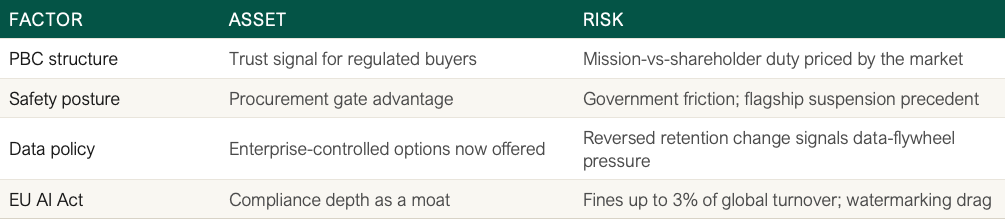
Anthropic’s public-benefit structure and safety framing are a genuine procurement advantage in banking, healthcare, and government, and enforcement of the EU AI Act’s general-purpose model obligations began August 2, 2026. But our public policy checks confirm that this positioning creates friction: the U.S. government briefly suspended access to a flagship model over a jailbreak concern, the company reversed a controversial 30-day data-retention policy after enterprise pushback, and its PBC charter obliges it to balance mission against shareholder returns. We’re looking for risk factors on regulation and government action, any contingent liabilities from the model-suspension episode, and how mission commitments (no ads!) could constrain shareholder returns.
Sources: Optimal Advisory, Anthropic, CNBC, Thompson
10/10
Does the AI category leader software offer visibility into a future business model?
Anthropic goes public as the enterprise LLM leader with the fastest revenue ramp on record, a deep coding moat, and a first profitable quarter in sight, priced at a multiple that looks defensible on run-rate and demanding on audited revenue. The decision to buy turns on whether revenue survives a shift to net reporting, whether gross margin is on a credible path, and whether the coding lead is widening or plateauing. The consumer gap, compute burn, commoditization, and governance, is a known risk already visible in the private data.
Sources: Optimal Advisory